About the roastery
Iconic is a small Slovenian micro-roastery based in Trbovlje (address listed as Novi dom 6a). Their “about” page reads like a gentle intervention: thanks to globalisation, great coffee is more accessible than ever—and yet we keep drinking bad coffee, mostly because we’ve learned to not care. Iconic’s stated goal is to fix that by offering coffee that’s enjoyable and a little challenging, in the “discover aromas and tastes you didn’t know you liked” sense, rather than the “tastes like battery acid, good luck” sense.
Their core slogan is the classic: “Life is too short for bad coffee.” It’s a line that has appeared on approximately fourteen million coffee bags since the dawn of Instagram, but to their credit they actually try to anchor it in something concrete: seasonal coffees, a small curated range, and a very “drink it fresh and pay attention” attitude.
A more personal bit of context comes from Slovenian writeups that name the people behind it (Valentina and Gregor/Grega) and frame the whole project as a long-running pursuit of the “perfect cup,” with a strong emphasis on coffee as memory and ritual – not just caffeine logistics.
Webshop selection
The shop itself is refreshingly simple: you’re not browsing fifty SKUs and twelve “limited drops” that sell out while you’re still reading the tasting notes.
At the time of checking, the core lineup is compact and practical—things like Brazil, Ethiopia Yirgacheffe, Burundi Masha, and Rwanda, plus a small gift set. The most telling detail isn’t the origin list though—it’s the usability: they offer multiple grind options (espresso, filter, French press, Turkish, etc.) and small bag sizes (100g / 125g / 250g), which makes it easy to sample without committing to a kilo of regret.
They’re also explicit that the coffees won’t always be the same: they aim to keep green coffee fresh and therefore rotate offerings by harvest/season. So if you fall in love with a specific lot, you should assume it’s temporary—like most good things.
There’s also a small accessory section, which I always appreciate. You’ll find the expected brewing staples: a scale, a V60 set, an AeroPress, a moka pot. All very sensible, all very usable.
And then — because this is Slovenia, after all – there’s cycling gear. A bib and a dress. Which, on second thought, is not surprising at all. If you’re going to fuel marginal gains, you might as well do it properly.
The selection overall isn’t huge, but it feels deliberate. Nothing looks randomly thrown in to pad out the catalogue. It’s compact, practical, and coherent.
As for the website itself… I can’t say I love it.
Functionally? No complaints. The coffee tiles are actually quite good — you get the profile and key details at a glance, which is exactly what you want when browsing beans. The selection process is straightforward, the ordering works, payment behaves. Everything does what it’s supposed to do.
Aesthetically though, it feels a bit undercooked.
Specialty coffee as a scene tends to orbit a certain visual language. You know the one. Clean typography. Lots of whitespace. Carefully chosen neutrals. The quiet confidence of “we own a Pantone book and we’re not afraid to use it.” This isn’t that.
And that’s not a functional criticism; it’s purely visual. But in a market where design and perception are tightly interwoven with perceived quality, aligning more closely with that aesthetic might not hurt. If nothing else, it would probably help bridge the gap between how the coffee presents on paper and how it’s perceived at first glance.
Again, nothing is broken. It just doesn’t quite whisper “specialty” in the way the coffee crowd has come to expect.
Order & delivery
On delivery they set expectations clearly (at least for domestic shipping): orders are sent out within two working days, typical delivery time is 1–3 working days, and shipping inside Slovenia is listed as €3.50, with free shipping above €60 (with some caveats). They mention Pošta Slovenije and GLS as delivery partners.
I’ve ordered from Croatia, and the shipping fee was 10€ (so no free international shipping over 60€?). I was notified that the package was shipped the same day as it was ordered – so they seem to be on top of that game. I assume it is not the same day roast though.
Delivery itself was quick. Packaging was fairly standard, but nicely done: clean, with a big, unapologetic logo.
The bags themselves look good.
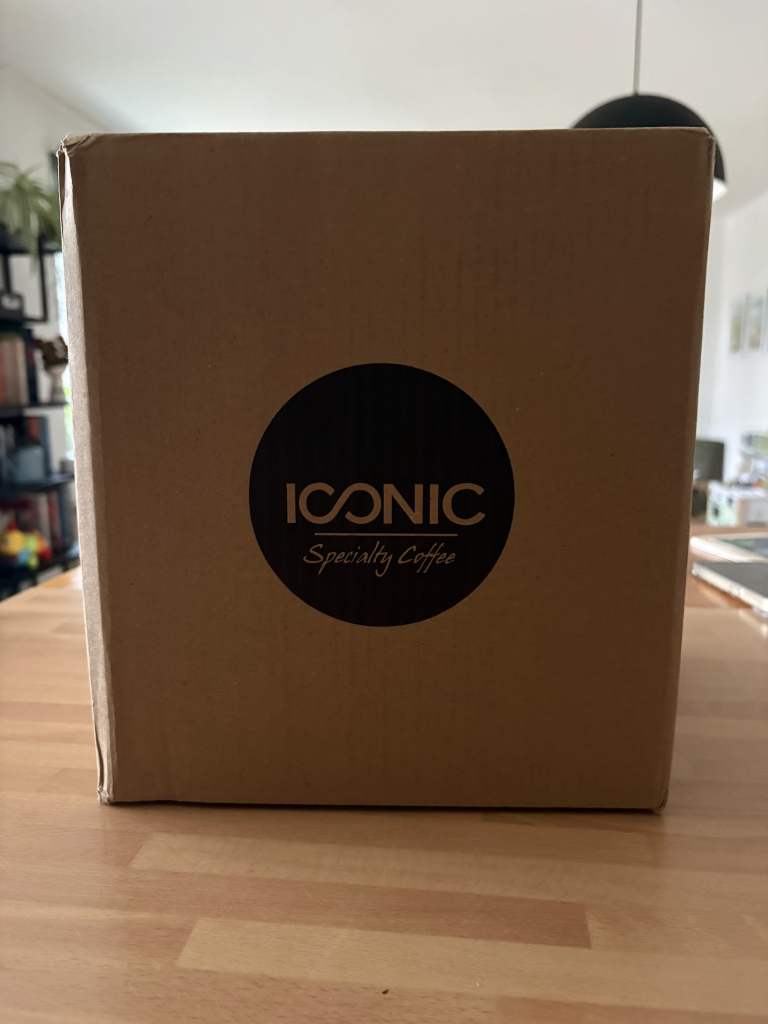
Coffee bags look nice:
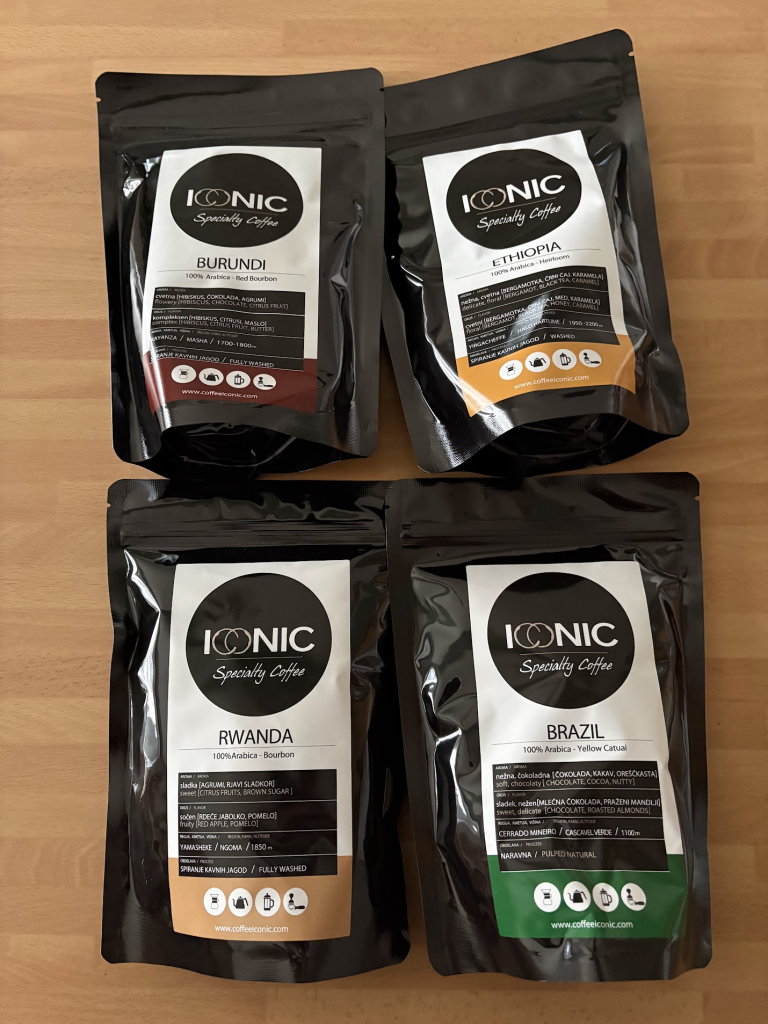
I know I complained about the website design earlier, but somehow it translates much better to physical packaging. The bags are informative, feel high quality, and overall give off a more “finished” impression than the site. They are plastic, which won’t be everyone’s favorite choice, but that’s a separate discussion.
They were also clearly freshly roasted — opening each bag confirmed that immediately. No complaints there.
Now, one thing I haven’t mentioned yet.
This coffee is… cheap.
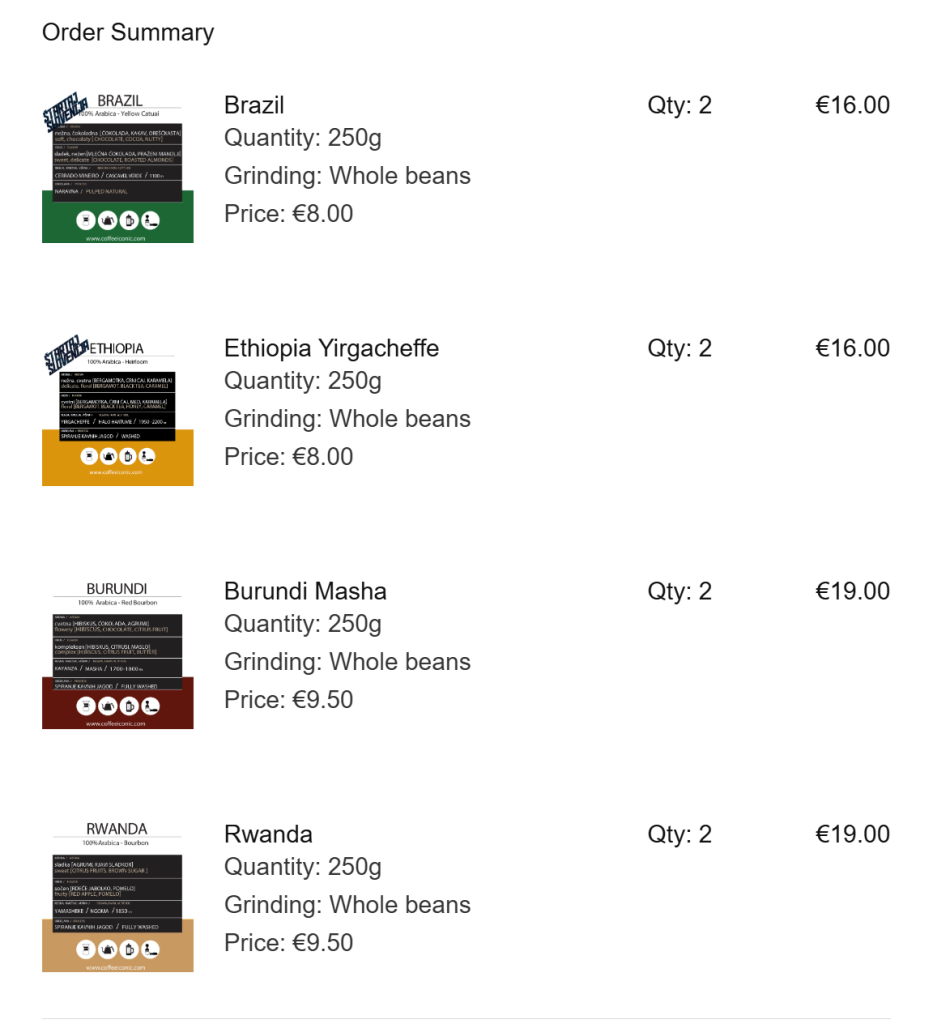
At less than half the typical €16–€20 price for a 250g bag, this is easily the cheapest coffee order I’ve had in a long time. Possibly ever.
And naturally, that raises a question.
Is this one of those rare “how are they doing this?” bargains – or are we about to find out exactly where the cost savings came from?
Let’s see.
Coffee
Now, the coffee.
I’ve actually finished all of it already and, to be honest, I’ve been putting off writing this part because I wasn’t entirely sure what to tell you.
On one hand, I genuinely enjoyed every single cup. I went through the lineup using espresso, AeroPress, and moka pot, and at no point did anything feel like a chore to drink. Burundi and Rwanda were… fine. Perfectly drinkable, but not particularly memorable. Ethiopia and Brazil stood out more, mostly because they felt a bit more rounded and complete in the cup.
But here’s the thing.
I can’t really give you strong, distinctive tasting notes. Not honestly, anyway. Even after reading the bags and doing the usual mental gymnastics (“yes, that is definitely a hint of some extremely specific floral note from a remote hillside somewhere”), nothing really jumped out in a convincing way.
And that’s where the comparison to something like Friedhats becomes unavoidable. With them, every coffee felt clearly defined — you knew what you were drinking, and it made sure you knew it too. Here, everything is much more… restrained.
Muted, maybe?
That’s not necessarily a bad thing, but it is noticeable.
What’s interesting, though, is that despite that lack of sharp identity, I still liked all of them. There wasn’t a single moment where I made a cup and thought, “oh… this one again.” If anything, they worked extremely well as reliable, no-drama daily drivers. Easy to brew, easy to drink, consistently good.
And maybe that’s the point.
Since I can’t say anything wildly specific about any individual coffee, this ends up being a shorter chapter than usual which, depending on your tolerance for tasting note poetry, might actually be a positive.
Not every coffee needs to be an existential experience. Some are just… good. And these are.
Final thoughts
As I’ve said before, I know people who drink the same coffee for 20–30–40 years. I can easily see this being someone’s that coffee.
It’s good enough to feel a bit special, definitely more than anything you’d get in a supermarket, but not so “special” that it feels like work. You don’t have to overthink it, it just makes a good cup.
And at that price point, it’s really hard to complain about anything.
My conclusion is simple: if this was the best coffee I could afford, I would not be unhappy. Quite the opposite.
I would probably get bored eventually, but that’s more of a me problem than an Iconic coffee problem.
I do recommend it. Everything about the experience was nice. They’ve found a good niche.
Leave a Reply